
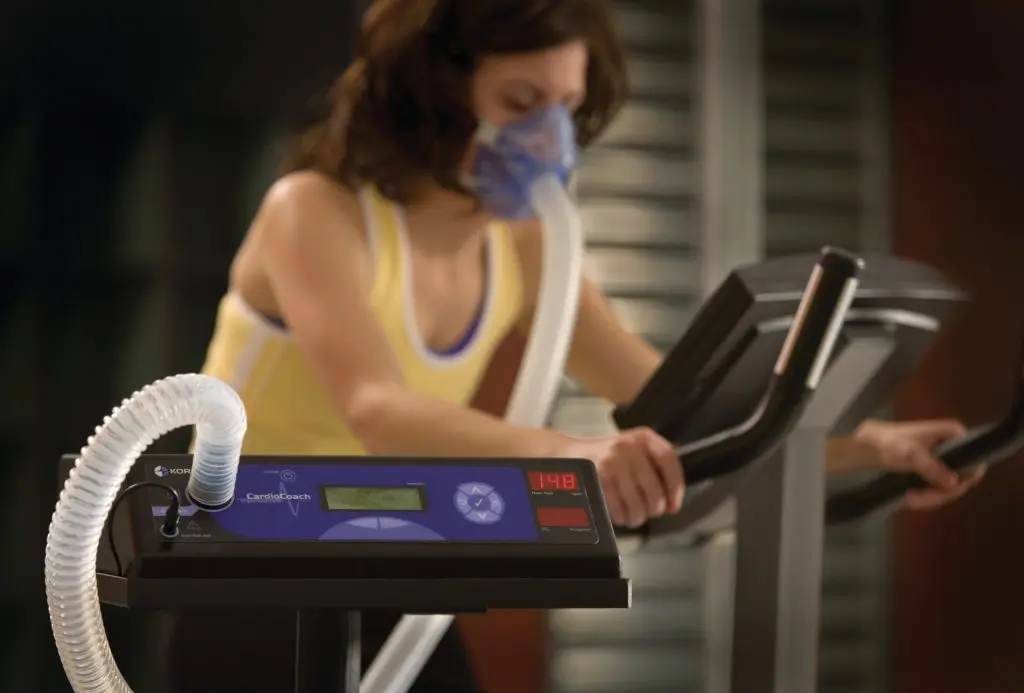
Lactate Threshold Testing
Yes, we do lactate testing. We also spend a lot of time helping athletes decide whether they actually need it.
Blood lactate is a useful field tool. In the lab, our metabolic cart usually gives richer, higher-resolution data for training zones, fuel use, and thresholds — without stopping you every few minutes to prick a finger.
If you came here looking for lactate testing, start with the short version below. If your situation matches one of the exceptions, we will run the lactate protocol you or your coach specify and give you the raw numbers.
The short version
- Most athletes should book a VO2 max test first. You get aerobic and anaerobic thresholds (the gas-exchange equivalents of LT1 and LT2), fat vs. carbohydrate calories at each intensity, respiratory data, and a VO2 max (measured or imputed once you are past anaerobic threshold).
- Lactate is a surrogate marker for carbohydrate use and lactate appearance/clearance — not a direct measure of fat and carb oxidation.
- The lactate curve is noisy and discrete. Fixed cutoffs (2 mmol/L = Zone 2, 4 mmol/L = threshold) and “eyeball the inflection” methods are common because there is no single standardized way to pick LT1/LT2 from a handful of points.
- We still run lactate tests when a coach has a defined protocol, when you need the first dip / first rise in Zone 1, when a mask is not workable, or when you already know how you interpret your own lactate history.
What lactate testing actually measures
Lactate is not just a waste product. It is a fuel that is produced, shuttled, and oxidized — including by other muscle fibers and the heart. Blood lactate concentration during a step test is still only a snapshot of the balance between production and clearance at that moment.
As intensity rises, glycolytic flux increases and more carbohydrate is used. Blood lactate tends to rise with that shift. That association is why coaches use LT1 (first sustained rise above baseline, often near ~2 mmol/L) as a stand-in for the top of truly aerobic work, and LT2 / MLSS / “onset of blood lactate accumulation” as a stand-in for the heavy-to-severe boundary.
Those associations are real at the group level. They are not the same thing as measuring substrate use. A metabolic cart that measures both oxygen consumption and carbon dioxide production can calculate fat and carbohydrate oxidation minute by minute. Lactate cannot.
- That gap shows up in practice:
- Fixed 2 mmol/L “Zone 2” often sits above the intensity where fat and carbohydrate oxidation start to diverge on gas-exchange data. In our testing, lactate-based Zone 2 frequently overestimates the true aerobic ceiling.
- Fatmax (highest fat-oxidation rate) and LT1 / gas-exchange threshold are related but not interchangeable in the individual athlete.
- LT2 is commonly taken as 4 mmol/L, D-max curvature, or a visual “exponential rise.” Those methods do not always agree with each other or with the anaerobic / ventilatory threshold from gas exchange.
- Lactate and ventilatory thresholds are correlated in many studies and still not identical events. They can dissociate.
What you get from the metabolic cart instead
Our cart measures oxygen use, carbon dioxide production, tidal volume, breathing frequency, and heart rate. From that we can see:
- Fat calories and carb calories per hour at each intensity — the actual fuel mix, not a proxy.
- Where fat and carbohydrate utilization diverge — the point we use to set the top of Zone 2.
- Fatmax — the intensity where you oxidize the most fat.
- The 50/50 fat–carb crossover, when it exists.
- Anaerobic threshold — where fat oxidation approaches zero and you are relying on carbohydrate (glycogen in the cytoplasm and lactate oxidized in mitochondria). On gas-exchange data this is identified when VCO2 crosses VO2 (RER = 1.0) and related ventilatory markers, rather than guessing the bend in a 6-point lactate plot.
- Respiratory pattern — tidal volume and breathing frequency. Some runners brace with the breath and never reach expected tidal volume; others hyperventilate. That does not show up on a lactate strip.
- VO2 pulse as a rough window on stroke volume / cardiac limitation.
- VO2 max if you go to a plateau, or a validated estimate if we take you just past anaerobic threshold (about a minute) without forcing a true max effort.
You do not have to go to exhaustion. If we get you past anaerobic threshold, the system can identify AT and estimate VO2 max from heart-rate trajectory and age-adjusted norms.
A continuous or short-stage ramp is also a cleaner metabolic stimulus. Lactate sampling requires you to stop (typically ~1 minute) at the end of each stage. Heart rate drops, metabolism shifts, then you restart. That is why lactate protocols use longer stages (often 3–5+ minutes) — so values can settle after the interruption. A smoother VO2 protocol can identify the same thresholds in a shorter, more continuous effort.
Note: some “VO2” labs use carts that do not measure CO2. Those systems cannot provide fuel partitioning. Ours does.
When lactate testing still makes sense
We will collect lactate when it adds something the cart does not, or when it is the data your coach already knows how to use.
- Your coach specified a protocol and will interpret the curve. We run the stages you request, record lactate, heart rate, and speed/power at each step, and hand over the raw data. We do not invent zones from a noisy 6-point curve. Zoning from lactate is too subjective unless you already have a method.
- You want the first dip / first rise in Zone 1. Early in a very easy start, lactate can fall as you clear it before carbohydrate flux rises enough to produce more. The subsequent tick-up is what some marathon and mountain coaches hunt for. That test has to start very slowly with long stages. It is a specialized protocol, not a standard threshold test.
- You cannot (or will not) wear a mask, claustrophobia, or a preference for fingersticks over spirometry.
- You have a long personal lactate history and want apples-to-apples repeats of the same meter and protocol.
- Field portability later. A lab VO2 test sets the map. A handheld meter can then be used outdoors. The meter is cheap and portable; the cart is not. That is the honest advantage of lactate — not superior threshold detection in the lab.
If none of those apply, book the VO2 max test. If the VO2 data still leaves a specific question unanswered, we can add lactate later.
If we do run a lactate test
Standard lab lactate session (about 60 minutes total):
- Protocol discussion and stage selection (you or your coach specify intensities).
- Mask and heart-rate monitor if we are also collecting gas exchange; otherwise heart rate and the ergometer only.
- Warm-up.
- Typically up to about seven stages of ~3 minutes, with ~1 minute between stages for a fingertip or earlobe sample.
- Recovery, raw data table (lactate, HR, speed or watts), and a conversation about what the numbers can and cannot support.
This is a submax step test. It does not produce a VO2 max by itself. Longer custom protocols (30–45 minutes at race pace for fueling, extra stages, longer steps) can be quoted separately.
You will get the raw values your coach asked for. You will not get a polished “your LT2 is exactly X” story unless the curve is unambiguous — many are not.
How to prepare
- Fast at least 4 hours (water is fine). Food in the gut changes fuel mix and can move both lactate and RER.
- No hard training the day before.
- Come hydrated. Wear the shoes / kit you train in.
- Treadmill or bike; cyclists may use a compatible bike on our trainer.
- If you have a heart-rate cap after injury, say so in advance. We can stop once AT / LT2 is clearly established if we’re also using the cart rather than pushing to volitional max — the same way we treat a capped VO2 test.
Which test should you book?
VO2 max (metabolic cart)
- Training zones — Set from measured fat/carb split and AT
- Fuel use (kcal fat vs carb) — Yes, at each intensity
- LT1 / aerobic threshold analogue — Yes (gas exchange + fuel divergence)
- LT2 / anaerobic threshold analogue — Yes (RER / V-slope / fat → 0)
- VO2 max — Measured or estimated past AT
- Breathing / cardiac clues — Tidal volume, frequency, VO2 pulse
- Protocol — Smoother ramp, ~10–20 min of work
- Best for — Almost everyone setting zones or fueling
Lactate step test
- Training zones — Subjective fit to a sparse curve or fixed mmol/L rules
- Fuel use (kcal fat vs carb) — No — inferred only
- LT1 / aerobic threshold analogue — First rise or ~2 mmol/L
- LT2 / anaerobic threshold analogue — Visual exponential rise, D-max, or ~4 mmol/L
- VO2 max — Not from a standard lactate protocol
- Breathing / cardiac clues — No
- Protocol — Interrupted steps; metabolism reset each stop
- Best for — Coach-prescribed raw data, first-rise protocols, no-mask cases
Next step
If you want training zones, fueling numbers, and thresholds: book a VO2 max test.
If your coach sent a lactate protocol, you need the Zone 1 first-rise, or a mask will not work: contact us and we will run lactate. Bring the exact stages they want.
Life Fit Labs · 555 Sun Valley Dr STE K4, Roswell, GA 30075 · 770-650-8334 · Contact